
I Looked Inside 300 Home Libraries. The Wealthy Ones Had the Same 9 Books
Your bookshelves may already be full, yet something about them can still feel unfinished. Maybe the books were bought at random, too many objects are fighting for attention, or everything was chosen because the covers happened to match.
The best home libraries usually work differently. Books remain the main event, and the collection says something about what the person living there actually likes, studies, reads, or hopes to learn.
There is no reliable evidence that exactly nine books appear in 300 wealthy homes. What we can verify is more useful. Architectural Digest asked working designers which design books they return to repeatedly, while House & Garden published a fresh designer and architect reading list in April 2026.
1. Why The Decoration of Houses Gives Your Home Library History

Book: The Decoration of Houses
Authors: Edith Wharton and Ogden Codman Jr.
If you want your home library books to include some real design history, start here. Wharton and Codman published The Decoration of Houses in 1897, long before decorating became an endless stream of online trends.
Architectural Digest has described the book as a foundation for later interior design writing. Its main ideas still feel surprisingly sensible: think about proportion, choose furniture for usefulness and comfort, and avoid decorating simply to impress other people.
That makes the book more interesting than an old volume chosen for its spine. It gives you a way to judge the rooms you see in newer books.
It is also a good reminder that expensive decorating and good decorating are not the same thing. Wharton and Codman were already criticizing showy rooms more than a century ago.
You may not agree with every example in the book. Some references come from grand European houses that have little connection to an average home today.
Still, that contrast is useful. A library becomes more interesting when old ideas sit beside new ones.
2. Why The Grammar of Ornament Adds More Than a Pretty Cover

Book: The Grammar of Ornament
Author: Owen Jones
Some large design books look beautiful but give you very little once the cover is opened. The Grammar of Ornament earns its size.
First published in the nineteenth century, the book gathers decorative patterns and motifs drawn from many historical traditions. Architectural Digest included it in its 2025 list of books designers repeatedly use as references.
That makes it useful if you care about wallpaper, rugs, tile, textiles, furniture details, or architectural decoration. You can open almost any section and start noticing how shapes repeat, how colors are balanced, and how patterns are built.
This is especially helpful if your shelves lean heavily on current decorating books. A historical reference breaks that pattern and gives the collection more depth.
You do not have to sit down and read it from beginning to end. It works better as a book you return to when you need an idea.
Place it where you can actually reach it. A reference book hidden on a shelf six feet above the floor quickly becomes decoration instead of a working part of your library.
3. What Mark Hampton on Decorating Can Teach You About Real Rooms

Book: Mark Hampton on Decorating
Author: Mark Hampton
A beautiful library needs more than books filled with beautiful photographs. You also want a few books that explain why a room works.
Mark Hampton on Decorating does that well. Architectural Digest included it in its 2025 professional reading list, where designer Ellen Hamilton praised its organization around rooms, color, and clear explanations.
That practical quality matters. You can use the book when choosing furniture, thinking about color, or trying to work out why a room feels slightly wrong.
It also helps keep your library from becoming a stack of expensive picture books that nobody opens. There is nothing wrong with visual books, but a good collection benefits from books that ask you to stop and think.
Try keeping this one near a desk or reading chair rather than burying it inside a perfectly arranged shelf.
The point is simple. A library looks more convincing when the books appear to have jobs.
Some inspire you. Some teach you. Some entertain you. The best shelves leave room for all three.
4. Why Case Study Houses Belongs in a Modern Home Library

Book: Case Study Houses
Author: Elizabeth A. T. Smith
If your library contains only decorating books, you are missing part of the picture. Architecture changes how you think about a room before paint, fabric, lamps, or accessories are added.
Case Study Houses looks at the famous American residential program that explored new approaches to modern housing. Architect Mathew McGrane selected the book for Architectural Digest’s professional reading list, pointing to its ideas about form, materials, and connections between indoor and outdoor space.
That makes it especially useful in a modern or mid century inspired home. But you do not need to live in a glass house in California to learn from it.
Look at window placement. Notice furniture scale. Study how rooms relate to gardens, patios, and views.
Those ideas can help even if your own home is small and traditional.
The book also changes the visual rhythm of a shelf. Architecture books often have a different scale and graphic style from decorating monographs, which stops a collection from feeling repetitive.
Buy it because the subject interests you first. The attractive spine is a bonus.
5. What Jacques Grange: Interiors Shows About Collected Rooms

Book: Jacques Grange: Interiors
Author: Pierre Passebon
One reason some expensive homes feel surprisingly relaxed is that everything does not appear to have been purchased together. Art, furniture, books, antiques, and newer pieces can come from very different places.
Jacques Grange: Interiors is useful for studying that kind of mix. Geremia Design told Architectural Digest that its studio repeatedly returns to the book and values the way Grange brings art into interiors while moving easily between styles.
That is an important lesson for your own shelves. You do not need nine books with matching beige covers to create a polished home library.
In fact, too much matching can remove the thing that makes books visually interesting. Different sizes, bindings, ages, and colors create natural variation.
Grange’s rooms also make a case for giving art some space near books. A painting above a lower bookcase or a small framed piece placed between sections can work better than filling every gap with decorative objects.
Study the rooms rather than trying to copy them.
The goal is not to make your home look wealthy. The goal is to make it look as though its contents arrived through years of real interest.
6. Why The Poetics of Space Makes a Library More Personal
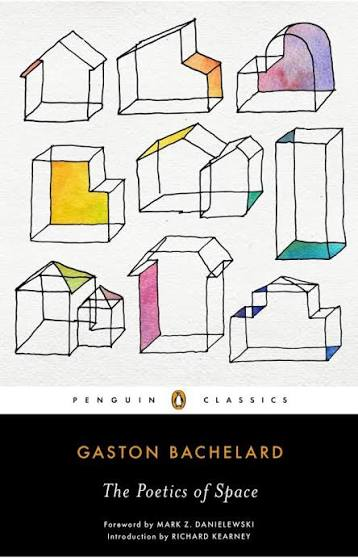
Book: The Poetics of Space
Author: Gaston Bachelard
A shelf full of oversized design books can begin to feel like a showroom. Adding a smaller text based book changes the mood immediately.
The Poetics of Space is a good example. Architectural Digest included it in its designer reference list, where Artem Kropovinsky of Arsight Studio discussed its focus on the way people experience rooms, corners, and ordinary places.
This is less about choosing the right sofa and more about thinking about why certain spaces stay with us. That makes it a smart companion to books focused on furniture and photographs.
It also brings the subject of the library back to the person using it.
A reading room is successful because you want to sit there. A window seat matters because you use it. A dark corner becomes valuable when it gives you a quiet place for an hour.
Pinterest’s Spring 2026 report fits that idea. Searches for “comfy reading chair small spaces” were up 455 percent, while “reading nook ideas” were up 245 percent.
People appear to want reading spaces they can actually use.
Your library should work the same way.
7. Why The Way We Live Works When You Cannot Name Your Style

Book: The Way We Live
Author: Stafford Cliff
Maybe you like old English rooms, clean modern houses, colorful apartments, simple coastal spaces, and rustic furniture at the same time. That is normal.
The Way We Live is useful because it does not force you into one narrow decorating identity. Designer Frances Merrill recommended it in Architectural Digest’s 2025 professional survey, describing the book as a broad starting point filled with homes from many parts of the globe.
A broad visual reference can help you spot your own patterns.
You may notice that the rooms you save all contain dark wood. Maybe you keep choosing striped textiles, deep wall colors, open shelves, or furniture that looks older than the building around it.
That information is more helpful than deciding you must follow one named style.
It is also how a personal library grows naturally. You add books because each one expands your view instead of because a list told you to own a certain number.
A wide ranging book like this is especially useful if two people share the room and have very different tastes.
Start marking the pages you both like. The overlap may tell you more about your home than any trend forecast can.
8. What A Place to Call Home Teaches About Quiet, Comfortable Rooms

Book: A Place to Call Home
Author: Gil Schafer III
If you like traditional rooms but worry about making your house feel formal, this is a useful reference.
Architect and designer Gil Schafer III is known for houses that draw from traditional architecture while still supporting modern life. Interior designer Nicole Fisher selected A Place to Call Home for Architectural Digest’s list and pointed to its millwork and small architectural details.
Those details matter in libraries.
Bookcases look more settled when they relate to doors, trim, ceilings, and the proportions of the room. A simple wall of shelves can feel much richer when its scale makes sense with the architecture around it.
You do not need custom walnut shelves to use that lesson.
Even an affordable bookcase can look more considered when its top aligns with nearby trim, several units are placed together, and gaps are handled carefully.
IKEA currently offers planning tools for its BILLY storage system along with broader room planning tools. That can help you test a layout before buying several bookcases.
Spend your attention before you spend more money. That principle works in almost every room.
9. Why Every Room Should Sing Stops a Library Feeling Too Serious

Book: Every Room Should Sing
Author: Beata Heuman
A traditional library can become stiff very quickly. Dark shelves, serious books, leather furniture, and perfect symmetry can make the room feel more like a club than your home.
Beata Heuman offers a useful counterpoint. House & Garden included Every Room Should Sing in its April 2026 HG101 library of books from favorite designers and architects.
Her work makes room for unusual color, surprising objects, pattern, and humor. That does not mean you need to copy every bold choice.
The larger lesson is more useful. Your room should contain evidence of your personality.
That might be an odd little painting found on vacation. It could be a chair inherited from a relative, a ceramic piece made by your child, or a row of paperbacks that have clearly been read many times.
Those pieces prevent the library from looking professionally staged and strangely empty at the same time.
House & Garden’s 2026 bookshelf guide makes a similar case for books themselves as a source of character. Its examples include shelves built into small and unexpected spaces rather than libraries treated as formal rooms reserved for large houses.
That makes this final book an important one. Taste gets more interesting when perfection loosens its grip.
6 Ways to Make Your Home Library Look Collected
Fill Shelves With Books First
Place your books before adding art, bowls, boxes, or other decorative objects.
Mix Book Positions
Combine upright books with a few low horizontal stacks to create natural variety.
Organize by Subject
Group books by topics such as art, interiors, travel, cooking, history, or fiction.
Connect the Shelves With Paint
Use one wall or shelf color to make separate bookcases feel like a built in feature.
Add Focused Reading Light
Place a floor lamp, table lamp, or library light near your reading chair and shelves.
Make the Library Look Used
Leave a current book by the chair, keep a small stack nearby, and let favorite books stay visible.
The Real Pattern Behind Beautiful Home Libraries
The strongest home libraries are not impressive because every book is rare or expensive. They work because the shelves reveal years of interest in architecture, art, places, people, stories, and ideas.
Start with one of these nine home library books if the subject genuinely interests you. Read it, mark pages, leave it open on the table, and let the next book come from something you discover inside it.
That slower approach produces the collected look people often try to buy all at once. And it costs less than filling an entire wall with books chosen simply because their spines happen to match.
Your library should tell people what you care about, not how much you spent on the shelves.